

Fiber internet is often talked about as the gold standard for connectivity, offering faster speeds, greater reliability, and a network built for the future. But for many homeowners, the installation process can feel a little mysterious. What’s happening in the street? Why are crews in the neighborhood? And how does that fiber actually make its way into your home?
At Utah Broadband, we believe informed customers are happy customers. That’s why we’re breaking down the fiber internet installation process step by step, from early construction to the moment your internet is live.
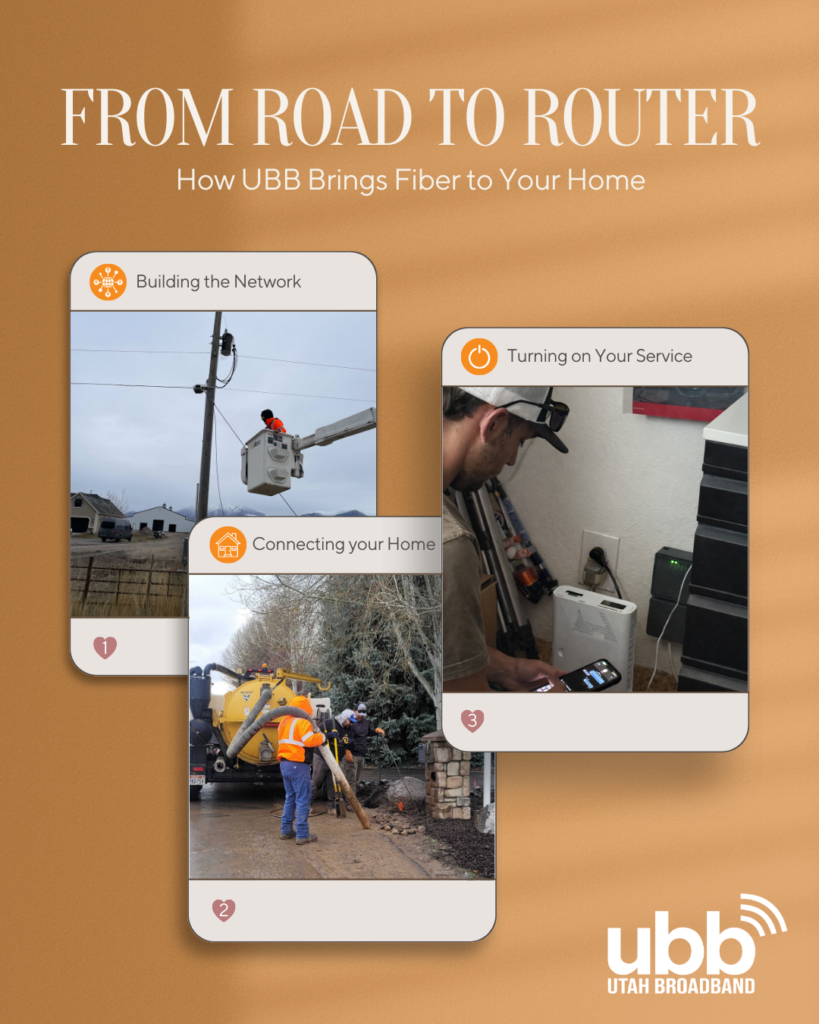
While every neighborhood and home is unique, most fiber installations follow the same three key phases, each occurring at a different time. Only the final step is scheduled directly with the customer, since we need access inside the home.
The three phases are:
- Running fiber along the roads
- Bringing fiber from the road to the home
- Bringing fiber into the home and activating service
Let’s walk through each step.
Step 1: Running Fiber Along the Roads
The first stage of a fiber internet build takes place well before service becomes available to individual homes. During this phase, crews construct the backbone of the network by installing fiber lines along roads, throughout neighborhoods, and between communities, creating the main infrastructure that will eventually serve homes and businesses.
Underground Fiber Installation
In many areas, fiber is installed underground. Crews use specialized equipment to place fiber conduit below the surface, often 2-3 feet underground, along roadways and utility corridors. This method minimizes disruption to existing infrastructure and keeps the fiber protected from weather and accidental damage.
You may notice narrow trenches, directional boring equipment, or small access points called handholes along the road. Once the conduit is in place, fiber lines are pulled through and securely housed underground.
At key points along the route, technicians splice fiber within protected enclosures. Fiber splicing is the precise process of fusing fiber strands end-to-end so data can travel seamlessly across long distances. These splice points are carefully tested to ensure signal strength and reliability before construction continues.
Aerial Fiber Installation
In some neighborhoods, especially rural or mountainous areas, fiber is installed aerially, meaning it is run through the air using existing utility poles. In these cases, fiber lines are attached to power poles and share space with other utilities, such as electrical or telephone lines.
Aerial installation allows Utah Broadband to reach areas where underground construction isn’t feasible due to terrain, rock, or environmental constraints. It’s a safe, efficient, and widely used method that still delivers the same high-quality fiber connection to your home.
Whether underground or aerial, this first step establishes the primary fiber routes that serve homes and businesses throughout the area.
Step 2: Bringing Fiber from the Road to Your Home
Once fiber has been installed along the road, the next step is connecting individual properties. This portion of the process is often called the “drop,” bringing fiber from the main line to your home.
The type of construction in the area does not automatically determine how the drop will be run. When the main construction is underground, the drop is almost always installed underground as well. In areas with aerial construction, the drop may be installed either aerially or underground. The final method depends on the property’s specific layout and existing utilities, and in these cases, it is roughly an even split between the two approaches.
Underground Drops
With an underground drop, a small fiber line is buried from the road or utility access point directly to your home. This line is typically installed just a few inches below the surface to minimize impact on your yard.
Our crews take care to avoid existing utilities and restore disturbed areas as best as possible. In many cases, grass naturally regrows over time, leaving little to no visible sign of the work.
Aerial Drops
With an aerial drop, the fiber may come from a nearby utility pole and run through the air to your home, similar to traditional power or phone lines. The fiber is securely fastened and routed to maintain safety, clearance, and durability.
When completing the drop, our crews will make every effort to contact the homeowner. Because this portion of the work does not require access inside the home, we will proceed with the installation if we are unable to reach you, provided there is a clear and appropriate location to run the line to the home.
Step 3: Bringing Fiber Into the Home
The final step is the one most customers are eagerly waiting for: bringing fiber into the home and activating service. It is the only phase scheduled directly with the customer, since we need access inside the home to complete the installation.
Entry Point and Equipment
We’ll find the best way to bring the fiber into your home, which may include using an existing entry point or drilling a small, discreet hole through an exterior wall if needed. Once inside, the fiber connects to an Optical Network Terminal (ONT), which converts the signal into high-speed internet for your home.
Your Utah Broadband technician will work with you to select a practical, discreet location for the equipment, typically near where other utilities enter the home.
Router Setup and Testing
Once the ONT is installed, your router is connected, and the service is activated. The technician will test the connection, confirm speeds, and ensure everything is working properly before completing the installation.
At this point, your home is officially connected to Utah Broadband’s fiber network and ready for streaming, gaming, remote work, and everything in between.
What to Expect During Construction
Because these three steps happen at different times, you may see crews in your neighborhood weeks or even months before your in-home installation appointment, and you may also notice activity on or near your property during the drop installation, even if your in-home installation has not yet been scheduled.
We understand that construction can be inconvenient, which is why we prioritize communication, safety, and restoration throughout the process. Our goal is to leave neighborhoods in great condition while delivering long-term benefits through a future-proof fiber network.
Why Fiber Is Worth It
While the installation process involves multiple steps, the result is a network designed to last decades. Fiber internet delivers symmetrical speeds, low latency, and unmatched reliability, making it ideal for modern households and growing communities.
From underground conduit to aerial lines on power poles, every step of the process is carefully planned to deliver fast, reliable internet to your home.
Connecting Utah, One Home at a Time
At Utah Broadband, we’re proud to invest in local communities by building and maintaining a high-quality fiber network. Whether your fiber is run underground or aerially, the goal is the same: delivering reliable, blazing-fast internet from the road to your home, and into your living room.
If you have questions about fiber construction or installation in your area, our team is always happy to help. We’re excited to connect you now and for years to come.